
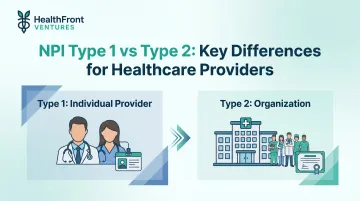
Introduction
The NPI question surfaces early in every healthcare provider's career—often during the first week of a new hire orientation or when filing the first independent practice LLC. And it's not just a paperwork issue. Choosing the wrong NPI type leads to rejected claims, stalled Medicare enrollment, and gaps in payer credentialing that can stretch for months.
This article clarifies the specific differences between NPI Type 1 and Type 2, who qualifies for each, when a provider needs both, and how to avoid the registration errors that trigger claim rejections. For nurse practitioners and physician assistants in rural or independent practice settings, this distinction carries real weight. These providers frequently shift between solo and organizational billing models, and administrative errors in that context can stall revenue for months.
Key Takeaways
- NPI Type 1 identifies individual providers (physicians, NPs, PAs), tied to your SSN — one per person, for life
- NPI Type 2 identifies organizations, group practices, or incorporated entities—tied to EIN, not SSN
- Sole proprietors need only Type 1; incorporated providers (LLC, PLLC, PC) need both
- Holding both types simultaneously is common and often required for incorporated practitioners
- Both are mandatory for HIPAA-compliant billing and Medicare/Medicaid enrollment; using the wrong type delays reimbursement
NPI Type 1 vs. Type 2: Quick Comparison
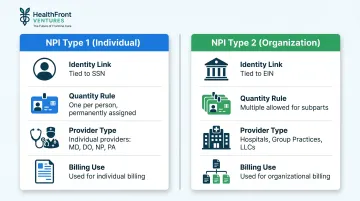
| Attribute | NPI Type 1 | NPI Type 2 |
|---|---|---|
| Who it's for | Individual healthcare providers | Organizations, group practices, incorporated entities |
| Tax identifier | Social Security Number (SSN) | Employer Identification Number (EIN) |
| Multiple NPIs allowed | No—one per person, permanent | Yes—organizations may hold multiple NPIs for subparts |
| Primary usage | Individual billing under provider's own name | Organizational billing under business name |
| Example entities | MD, DO, NP, PA, sole proprietor | Hospital, group practice, LLC, PLLC, HMO, clinic |
Note that holding an NPI does not guarantee licensure, credentialing, health plan enrollment, or payment reimbursement — it is an identifier only.
What Is NPI Type 1?
NPI Type 1 (Entity Type 1) is the National Provider Identifier assigned to individual healthcare providers. It's a permanent 10-digit number administered by the National Plan and Provider Enumeration System (NPPES) under CMS. The number does not encode specialty, state, or provider type information.
Who Qualifies for a Type 1 NPI
Any individual licensed to provide healthcare services qualifies, including:
- Physicians (MD/DO)
- Nurse practitioners
- Physician assistants
- Dentists
- Physical therapists
- Psychologists
- Chiropractors
- Pharmacists
- Audiologists
One NPI Per Person — and It Never Changes
Each individual receives exactly one Type 1 NPI. It does not change if you:
- Move states
- Change specialties
- Join a group practice
- Form an LLC later in your career
Per 45 CFR 162.408, the National Provider System must "assign a single, unique NPI to a health care provider."
CMS clarifies that the NPI "is expected to remain unchanged even if a health care provider changes his or her name, address, provider taxonomy, or other information that was furnished as part of the original NPI application process."
Sole Proprietor Nuance
Sole proprietors—healthcare providers who have not incorporated—are classified as Entity Type 1, not Entity Type 2. Even if you have employees or use an EIN for payroll, you still apply for and use only a Type 1 NPI.
Many providers get this wrong. According to the CMS-10114 application form, "A sole proprietorship is an Entity Type 1 (Individual)...sole proprietorships are not organization health care providers." The form instructs: "Sole proprietorships must report their SSNs (not EINs even if they have EINs)."
A sole proprietor is an individual provider — full stop — even when operating a business with employees. Once you incorporate (LLC, PLLC, or PC), the legal status changes and a Type 2 NPI becomes required for that entity.
What Is NPI Type 2?
NPI Type 2 (Entity Type 2) is assigned to organization health care providers—any entity that is not an individual provider. It's tied to the organization's EIN, not any individual's SSN, and is used when billing insurance under an organizational name.
Who qualifies:
- Hospitals
- Group practices
- Clinics and outpatient centers
- Health maintenance organizations (HMOs)
- Home health agencies
- Nursing homes
- Laboratories
- Pharmacies
- Durable medical equipment (DME) suppliers
- Residential treatment centers
- Telehealth companies
An organization can have as few as one employee and still qualify as a Type 2 entity. What matters is legal structure, not size.
Subpart rule:
Large organizations with multiple locations or service lines may need separate Type 2 NPIs for each subpart that conducts HIPAA transactions independently. For example, a hospital offering acute care, pharmacy, and rehabilitation services may require three NPIs if each service line bills separately.
Per 45 CFR 162.410(a)(1), a covered entity must "obtain...an NPI...for any subpart of the covered entity that would be a covered health care provider if it were a separate legal entity."
CMS's NPI Fact Sheet on Subpart Determination adds that "a subpart that conducts any of the HIPAA standard transactions separately from the 'parent' must have its own unique NPI."
Incorporated individual scenario:
A solo provider who has formed an LLC, PLLC, or PC is considered both an individual provider (Type 1) and an organization (Type 2). You must obtain—and actively use—both NPI types. This is the critical edge case most providers miss during initial enrollment.
Rural health organizations are a particularly common Type 2 scenario. As of March 2026, approximately 5,650 rural health clinics operate throughout the United States — many employing multiple NPs or PAs, each of whom also holds an individual Type 1 NPI for credentialing and billing.
Which NPI Type Do You Need?
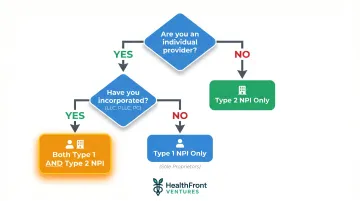
Use this decision logic framework to determine your NPI requirements:
If you are an individual provider billing under your own name and SSN: → Type 1 only
If you are an organization or group practice billing under an EIN: → Type 2 required
If you are a sole proprietor with employees but no corporation: → Type 1 only
If you have incorporated (LLC, PLLC, PC) and also see patients directly: → Both Type 1 and Type 2
Billing Trigger
The determining factor is not just legal structure but how claims will be submitted. If you submit claims under your personal name and identifier, Type 1 applies. If claims go out under a business name with an EIN, Type 2 is required. Both types may be active simultaneously for different billing contexts.
PLLC/LLC Scenario
A nurse practitioner or physician assistant who forms a PLLC to operate their practice needs a Type 2 NPI for the PLLC entity, but retains and continues to use their Type 1 NPI as the individual clinician. CMS states: "If you are an individual who is a health care provider and who is incorporated, you may need to obtain an NPI for yourself (Type 1) and an NPI for your corporation or LLC (Type 2)."
Common Registration Mistakes
- Applying as Type 2 when billing individually: Leads to claim rejection. CMS's October 2007 NPI implementation guidance explicitly warns: "The type of NPI you use (Entity Type 1 or Entity Type 2) must match your Medicare enrollment PIN (individual or organization)."
- Failing to register a Type 2 when incorporating: Creates enrollment delays with Medicare/Medicaid and prevents organizational billing setup.
- Skipping NPPES updates when organizational information changes: Per 45 CFR 162.410(a)(4), providers must "communicate to the NPS any changes in its required data elements in the NPS within 30 days of the change." Failure to update EIN, address, or ownership information creates compliance gaps.
Rural Health Workforce Management
Organizations managing rosters of rural NPs and PAs—such as rural health clinics or state Rural Health Transformation programs—need to track both the Type 1 NPIs of individual providers and the Type 2 NPIs of their facilities to ensure uninterrupted billing and enrollment compliance. HealthFront Ventures builds data infrastructure specifically for this challenge, helping rural health organizations maintain accurate, current provider NPI records across multiple counties without relying on manual tracking.
Conclusion
NPI Type 1 and Type 2 are not interchangeable. Each serves a distinct purpose tied to whether healthcare services are billed by an individual or an organization. The right choice depends on business structure, billing setup, and whether the provider has incorporated. Many providers need both, and that's by design, not redundancy.
Getting NPI registration right from the start prevents claim rejections, enrollment delays, and credentialing gaps. For rural providers and organizations navigating workforce growth and payer enrollment, getting this right accelerates credentialing timelines, keeps claims moving, and removes one of the most common bottlenecks in building a functional rural HCP workforce.
Frequently Asked Questions
What is the difference between a Type 1 and Type 2 NPI?
Type 1 is issued to individual healthcare providers and tied to their SSN. Type 2 is issued to organizations or group entities and tied to an EIN. Each serves distinct billing and identification purposes in HIPAA-covered transactions.
Do I need a Type 1 or Type 2 NPI?
Individual providers billing under their own name need Type 1. Organizations billing under a business name need Type 2. Incorporated solo providers typically need both.
Can a sole proprietor have a Type 2 NPI?
No. A sole proprietor who has not incorporated qualifies only for a Type 1 NPI, even with employees or an EIN. You need a Type 2 only once you form a legal organizational entity such as an LLC, PLLC, or PC.
Can a PLLC have both a Type 1 and a Type 2 NPI?
The PLLC itself holds the Type 2 NPI, while the individual provider who owns and practices within the PLLC retains their separate Type 1 NPI. Both are typically required for insurance enrollment under the organizational structure.
Can a provider hold both a Type 1 and Type 2 NPI at the same time?
Yes. This is common and often required, for example when a physician owns an incorporated group practice and uses their Type 1 NPI for individual patient care and the Type 2 NPI when billing under the organization's name.
How do I apply for an NPI through NPPES?
You can apply online through the NPPES web portal, by mailing a completed CMS-10114 form to the NPI Enumerator, or through an Electronic File Interchange Organization (EFIO) for bulk enrollment. Most individual providers receive their NPI within 10 days of submitting online.