Introduction
Healthcare organizations that rely on generic, one-size-fits-all messaging consistently see poor engagement rates. The reason is straightforward: HCPs, patients, and payers have completely different priorities, decision triggers, and information needs.
A rural Nurse Practitioner managing a high patient load in Montana needs different content, delivered through different channels, at different moments than a hospital-based cardiologist evaluating new therapeutics or a Medicaid administrator assessing population health ROI.
Static demographic profiles alone—"cardiologists in the Southeast" or "diabetes patients aged 50-65"—fail to capture the "why now" behind behavior. Segmented email campaigns yield 90.7% higher click-through rates than non-segmented campaigns, and 80% of individuals are more likely to schedule a healthcare appointment when offered a personalized experience. Intent-based segmentation closes this gap by layering real-time behavioral signals—search queries, content consumption, digital engagement—onto demographic data to reveal who is ready to act now, not just who exists in a database.
This guide walks through the complete framework — from segmentation types and audience-building to implementation strategy and compliance requirements — so you can move from static lists to signals that actually drive action.
Key Takeaways
- Healthcare audience segmentation uses demographics, behavior, geography, and intent signals — not just job titles or diagnoses
- The three primary segments are Healthcare Professionals, patients/consumers, and payers/health systems, each requiring distinct criteria and messaging strategies
- Intent-based segmentation adds real-time behavioral signals on top of demographic data to reveal who is ready to act now
- Effective segmentation depends on integrated data infrastructure, HIPAA-compliant sourcing, and continuous measurement
What Is Healthcare Audience Segmentation (and Why Intent Is the Missing Layer)
Healthcare audience segmentation is the process of dividing a broad healthcare audience into smaller, well-defined groups based on shared characteristics—demographic, behavioral, geographic, or psychographic—so marketing resources, messaging, and content can be precisely aligned to each group's specific needs and context.
The Traditional Limitation
Most healthcare organizations apply segmentation at the demographic or specialty level—"cardiologists in the Southeast" or "Type 2 diabetes patients"—but stop there, missing the behavioral layer that reveals motivation and readiness. In practice, this flattens meaningfully different providers into a single audience label. A first-year NP in rural Montana and a seasoned hospital-based cardiologist both qualify as "HCP," despite having almost nothing in common in terms of practice context, patient volume, or information needs.
Definitive Healthcare's Digital Audiences platform illustrates what granular segmentation actually requires — 500+ unique health attributes across 225 million consumer records and 3 million HCPs, covering:
- Social determinants of health
- Insurance coverage and payer mix
- Clinical interests and therapeutic focus
- Prescriber behavior and script volume
- Provider affiliations and care settings
Intent-Based Segmentation: The Missing Layer
Behavioral signals—search queries, content downloads, CME engagement, site visit patterns, and digital interactions—reveal what a specific audience is actively seeking right now. Static demographic profiles tell you who someone is. Behavioral data tells you what they need today, making segmentation predictive rather than just descriptive.
That gap between knowing your audience and reaching them in the right channel has a measurable cost. IQVIA's 2025 survey of 33,000+ HCPs across 38 countries found only 43% channel alignment in the UK, with oncologists and haematologists falling below 50%. When preferred channels don't match actual engagement channels, budget leaks and outreach goes unread. Intent-based segmentation closes that gap by aligning message delivery to demonstrated behavior — not assumed preference.
The Four Core Types of Healthcare Market Segmentation
Demographic and Geographic Segmentation
Demographic and geographic segmentation forms the foundational layer: age, gender, income, specialty, license type, and location. This approach is scalable, accessible, and easy to standardize—but static, with no indication of readiness or motivation.
Geographic segmentation carries particular weight in rural healthcare. 63.1% of all designated primary care HPSAs are located in rural areas, serving approximately 92 million residents. These disparities mean that geography alone—without layering workforce composition, scope-of-practice, and behavioral data—produces incomplete audience models.
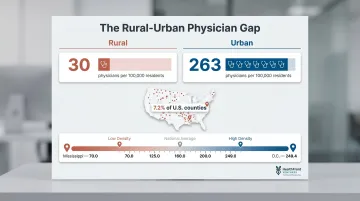
The rural-urban physician gap makes this concrete:
- Rural areas average 30 physicians per 100,000 residents vs. 263 in urban areas
- 7.2% of U.S. counties have zero primary care physicians
- Mississippi has the lowest PCP ratio at 70.0 per 100,000; Washington, D.C. peaks at 249.4
For rural healthcare organizations like HealthFront Ventures, layering practice geography with NP/PA licensure status surfaces underserved provider populations that pure demographic filters miss entirely.
Psychographic and Behavioral Segmentation
Psychographics capture values, health beliefs, and attitudes toward treatment or technology adoption. Behavioral data reflects actual actions—prescribing patterns, content consumption, platform usage, purchase history.
Combining these layers creates multi-dimensional personas. A peer-reviewed framework describes three patient psychographic personas:
- Self-Achievers: Goal-oriented, highly receptive to health information
- Priority Jugglers: Unengaged in self-care, influenced by family/peer pressure
- Willful Endurers: Live in the "here and now," least engaged with health systems
Each persona requires distinct channel selection and messaging tone. Performance data validates this approach: psychographic-based digital engagement produced a 90% reduction in CHF hospital readmissions and a 38% increase in medication adherence program signups.
Intent-Based Segmentation
Demographic and psychographic data describe who your audience is. Intent data shows what they're doing right now—making it the layer that connects audience modeling to actual purchase timing. It's built from real-time signals:
- Active search terms
- Content engagement depth
- Form completions
- Return site visits
- CME participation
57% to 70% of the healthcare B2B buying process occurs before a buyer contacts a vendor, and 9 out of 10 buyers say content has a moderate-to-major effect on purchasing decisions. Intent data reveals this "dark funnel" activity.
Intent-based segmentation differs from retargeting. Retargeting reaches people who already engaged with your content. Intent-based prospecting surfaces new, high-readiness audiences based on their current research behavior across the broader web.
Bombora's intent data cooperative tracks 12,000+ topics—including 400+ healthcare-specific topics across 5,000+ B2B websites. This lets marketers identify accounts actively researching specific therapeutic areas or technologies well before those accounts ever visit your site.
The Three Primary Healthcare Audience Segments
Healthcare Professionals (HCPs)
Key Segmentation Criteria
| Criterion | Application | Example |
|---|---|---|
| Specialty and license type | Determines clinical focus and prescribing authority | NP/PA vs. MD/DO; cardiology vs. family medicine |
| Practice setting | Shapes content format and delivery | Solo rural practice vs. large hospital network |
| Patient load | Influences content length and accessibility | High-volume providers need concise, evidence-ready summaries |
| Prescribing behavior | Indicates openness to new therapies | Volume, therapeutic area, adoption patterns |
| Channel preference | Optimizes engagement | Face-to-face, email, conferences, journals |
An estimated 374,970 primary care NPs and 29,433 primary care PAs practice nationally, with 44% of PAs expressing interest in rural locations.
For rural workforce recruitment, segmenting by NP/PA licensure status and practice geography is essential. HealthFront Ventures, for example, applies these criteria specifically to reach underserved rural provider populations with retention and recruiting outreach.
Intent Signals for HCPs
Intent signals distinguish HCPs in awareness stage (researching a therapeutic area) from decision stage (comparing specific products or evaluating job opportunities):
- Clinical guideline searches
- CME content consumption
- Engagement with drug interaction tools
- Participation in specialty webinars
- EHR-adjacent digital activity
97% of physicians report reading current issues of medical journals, underscoring journal-based content as a high-engagement channel for clinical-stage HCPs.
Channel Preferences Vary Significantly
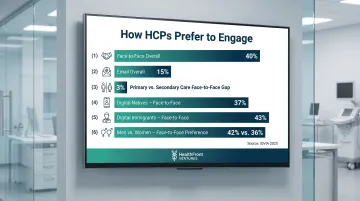
IQVIA's 2025 survey found:
- Face-to-face preferred by 40% overall
- Email preference reached 15% (new peak in 2025)
- Primary care HCPs prefer face-to-face 3% more than secondary care
- Digital natives (born after 1980): 37% prefer face-to-face
- Digital immigrants (born before 1980): 43% prefer face-to-face
- Men 42% prefer face-to-face; women 36% (women prefer email, conferences)
HCP segmentation sets the foundation. The second audience segment — patients — demands an entirely different framework, one built around where individuals are in their care journey rather than their clinical credentials.
Patients and Consumers
Key Segmentation Criteria
Patient segmentation requires layering multiple data types:
- Demographic and socioeconomic profile: Age, income, education, insurance status
- Health status and comorbidity burden: Diagnosis codes, treatment history, disease severity
- Stage in care journey: Pre-diagnosis, newly diagnosed, chronic management, post-treatment
- Digital behavior and channel preference: Device usage, platform activity, content format preferences
Care-journey stage is the variable most likely to be underused — and it carries significant weight. A newly diagnosed patient needs education and reassurance. A long-term chronic condition patient needs motivation, adherence support, and self-management tools. 57% of patients research treatment options independently before asking a doctor (up 16% since 2022), making the awareness stage a critical engagement window.
Privacy-Compliant Data Sources
| Data Type | How It Works | HIPAA Compliance |
|---|---|---|
| De-identified modeled claims | Built from diagnosis codes, prescription history, procedural data | Uses Safe Harbor or Expert Determination methods |
| Behavioral targeting | Browsing patterns, search behavior, look-alike audiences | No PHI collected; based on anonymous digital activity |
| Contextual targeting | Ad placement aligned with content themes patients are reading | No individual tracking required |
| Location-based targeting | GPS and IP data for geographic precision | Aggregated at census block level |
IQVIA Digital builds audiences using 150+ longitudinal health data streams with daily refreshes, employing Federated Audience Modeling and an independent ethics board to ensure consumer audiences remain de-identified and privacy-compliant.
Where patient segmentation focuses on the individual, the third segment — payers and health systems — shifts the lens to institutional decision-makers who control access, coverage, and budget.
Payers and Health Systems
Key Segmentation Criteria
Payer segmentation operates on institutional variables rather than individual clinical or behavioral data:
- Payer type: Public (Medicare/Medicaid) vs. private employer-sponsored vs. regional plans
- Coverage and formulary model: Open vs. closed formularies, prior authorization requirements
- Cost-containment priorities: Reducing readmissions, improving adherence, avoiding high-cost interventions
- Negotiation position: Market share, competitive dynamics, regulatory constraints
For health systems and rural health organizations, add:
- Geographic footprint and population served
- State-level Rural Health Transformation program alignment
- Budget constraints and financial sustainability
Rural Health Transformation Program Context
The $50 billion Rural Health Transformation Program ($10 billion annually, 2026-2030) was awarded across all 50 states in December 2025. Largest state awards include Texas ($281M), Alaska ($272M), and California ($234M). Lead agencies vary by state: Medicaid agencies, Departments of Health, joint leadership models, or executive offices.
This creates a new institutional variable for payer and health system segmentation: RHTP participation status. Organizations aligned with state RHTP initiatives represent a distinct segment motivated by workforce sustainability, access equity, and measurable quality metrics. For these organizations, workforce data tools like HealthFront Ventures' FY25 Baseline Data Metrics directly address the measurement requirements built into RHTP accountability frameworks.
Messaging Strategy by Segment
- Public payers: Require regulatory alignment and population-level ROI evidence
- Private payers: Respond to cost-offset simulations and real-world outcomes data
- Rural health systems and RHT programs: Motivated by workforce sustainability, access equity, and quality metrics
How to Build an Intent-Based Healthcare Segmentation Strategy
Step 1 — Define Objectives and Audience Scope
Start from the program or campaign objective and work backward to define the audience. Objectives must be specific and measurable to support later evaluation.
Examples:
- Increase NP/PA recruitment in rural counties with zero primary care providers
- Improve adherence among newly diagnosed Type 2 diabetes patients
- Drive formulary placement among regional Medicaid plans
Specify both who needs to be reached and what behavioral state they need to be in for the message to be relevant.
Step 2 — Collect and Integrate Data Across Sources
Combine first-party data (CRM records, email engagement, website analytics) with third-party data (claims data, specialty registries, behavioral data providers, programmatic DSP audience signals).
Challenge for rural organizations: Rural healthcare organizations and state RHT programs often lack the internal infrastructure for custom data builds. Rural hospitals achieve only 64% health data availability compared to 84% for metro hospitals, with an 18-percentage-point gap in electronic data use.
Solution: Pre-built, outsourced data infrastructure can close this gap without requiring custom engineering. HealthFront Ventures, for example, offers HCP workforce data warehouses that include FY25 baseline metrics for benchmarking workforce segment characteristics — removing the build burden from rural organizations that lack in-house data teams.
Step 3 : Build Intent-Enriched Personas
Develop segment profiles that combine static attributes — demographics, specialty, geography — with dynamic intent signals drawn from active search behavior and content engagement.
Include in each persona:
- Top search terms observed in the segment
- Preferred content formats
- Peak engagement windows
- Primary channels
Revisit personas each campaign cycle — intent signals shift as market conditions and workforce trends change.
Step 4 : Map Messaging to Segment and Journey Stage
Build a messaging matrix that aligns content type to each segment at their specific journey stage:
| Journey Stage | Content Type | Example |
|---|---|---|
| Awareness | Educational, problem-focused | "Why rural providers are leaving practice" |
| Consideration | Evidence-based, solution-focused | "How retention incentives reduce turnover" |
| Decision | Specific, action-focused | "Apply for our rural NP retention program" |
| Retention | Ongoing support, community | "Success stories from our rural providers" |
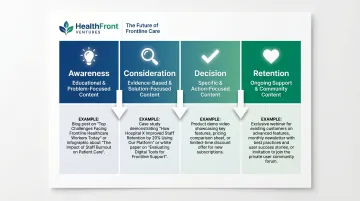
Prioritize modular content architecture so core messaging can be adapted for HCPs vs. patients vs. payers without rebuilding from scratch.
Common mistake: Sending decision-stage content to awareness-stage audiences and vice versa. A recruitment ad targeting an HCP who hasn't yet decided to relocate will underperform compared to educational content about rural practice benefits.
Step 5 : Measure Performance and Iterate
Define KPIs per segment:
- HCP campaigns: Cost per qualified action (CPQA), engagement rate, prescribing behavior lift
- Patient outreach: Portal enrollment, adherence metrics, satisfaction scores
- Payer campaigns: Formulary placement rates, meeting conversion
Use performance data to refine personas, adjust content sequencing, and apply retargeting to high-intent segments that did not convert on initial exposure.
Data Infrastructure, AI, and Privacy in Healthcare Segmentation
AI and Machine Learning for Segmentation Precision
Machine learning algorithms analyze large, multi-source datasets—claims data, EHR-adjacent records, digital behavior logs—to identify non-obvious patterns, score segments by predicted engagement likelihood, and surface high-value audiences that manual segmentation would miss.
22% of healthcare organizations have implemented domain-specific AI, a 7x increase over 2024. Adoption by sector: health systems 27%, outpatient providers 18%, payers 14%. Healthcare AI deployment proceeds 2.2x faster than the broader economy.
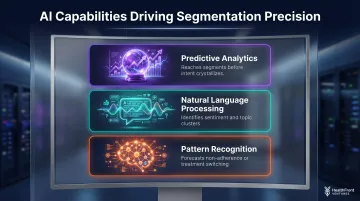
Three capabilities drive segmentation precision:
- Predictive analytics reach segments before intent fully crystallizes, enabling proactive outreach
- Natural language processing identifies sentiment and topic clusters in public health data
- Pattern recognition across behavioral signals forecasts non-adherence or treatment switching
Rural AI case study: Sanford Health deployed ambient AI scribing to 250+ physicians. Their "Jane" agentic AI tool increased appointment connect rates from 40% to 56%. Virtual neurology consultations produced a 14.7% reduction in length of stay and halved readmission rates.
That same analytical power creates real privacy exposure — which is why compliance and ethical guardrails aren't optional additions to an AI segmentation strategy.
HIPAA Compliance, Data Privacy, and Ethical Safeguards
De-Identification Standards
Two federally recognized de-identification methods apply to healthcare segmentation data:
Safe Harbor Method (45 CFR 164.514(b)(2)) — Requires removal of 18 specific identifiers, including:
- Names, phone numbers, email addresses, SSNs, and medical record numbers
- Geographic subdivisions smaller than state level
- Dates except year, IP addresses, biometric identifiers, and full-face photographs
Expert Determination Method (45 CFR 164.514(b)(1)) — A qualified expert must determine that re-identification risk is "very small" and document both the methods used and the results.
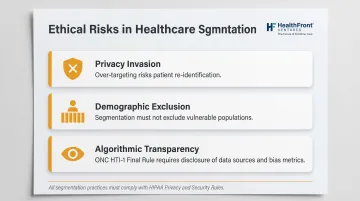
Ethical Risks Unique to Healthcare Segmentation
- Privacy invasion through over-targeting: Using too many data points can re-identify individuals
- Demographic-based exclusion that introduces disparities: Segmentation must not systematically exclude vulnerable populations
- Algorithmic transparency: ONC's HTI-1 Final Rule establishes first-of-its-kind transparency requirements for AI and predictive algorithms in certified health IT, including disclosure of data sources, performance metrics, and potential biases
Modeled claims analysis merges a sample of probable patients with an anonymous population to ensure sufficient anonymity — a standard technique for balancing actionable insight with individual protection.
Technology Stack Essentials
The functional layers of a healthcare segmentation stack include:
- CRM platforms that build dynamic audiences based on behavioral triggers
- Programmatic DSPs that execute real-time bidding against those segments
- Behavioral data providers supplying intent signals from third-party networks
- AI-driven personalization tools that adapt messaging at the individual level
Rural healthcare organizations and smaller programs rarely have the staff or budget to build this stack from scratch. Outsourced infrastructure removes that barrier — delivering segmentation capability without a custom build.
Common Mistakes to Avoid in Healthcare Audience Segmentation
Over-Relying on Static, Single-Dimension Segments
Treating job title, license type, or diagnosis alone as sufficient criteria results in broad, low-relevance campaigns—the "right audience, wrong moment" problem. Adding behavioral and intent layers transforms a demographic list into an actionable, timely segment.
Environment and context matter as much as user profile. Content optimized for email can perform very differently in a programmatic environment or an EHR-integrated system. Effective segmentation accounts for all three dimensions:
- Channel context: Where the HCP or patient encounters the message
- Behavioral signals: What actions indicate current intent
- Profile attributes: Job title, specialty, or care setting as a baseline filter
Research consistently shows that static channel strategies—ones that ignore individual HCP preferences—drive measurable drops in engagement and campaign ROI across US health systems.
Ignoring Care-Journey Stage and Underutilizing CRM Capabilities
Most healthcare CRMs are used as contact databases rather than dynamic segmentation engines. Journey-stage logic—mapping content triggers to specific phases of the awareness-to-action path—transforms a static list into a responsive communication system.
Common stage mismatches:
- Sending educational content to a decision-ready HCP
- Sending a conversion-focused ad to a newly diagnosed patient Either misstep reduces engagement and erodes the trust that took months to build.
68% of consumers report frustration when healthcare websites show irrelevant actions, and 79% expect personalized experiences. These numbers reflect what happens when journey-stage data is absent: generic outreach that misreads where the audience actually is.
Frequently Asked Questions
What is segmentation in healthcare (including health data segmentation)?
Healthcare segmentation divides patients, HCPs, or payers into defined groups based on shared traits—demographics, behavior, health status, or geography—so marketing and care delivery can be tailored to each group. Health data segmentation refers specifically to using clinical datasets like claims, EHR records, and diagnostic codes to identify and categorize these groups.
What are the main types of market segmentation?
The four primary types are demographic, geographic, psychographic, and behavioral. In healthcare, intent-based segmentation—using real-time behavioral signals to identify readiness—functions as a fifth, high-value layer on top of these foundational types.
What are the steps to perform market segmentation?
- Define your objective and audience scope
- Collect and integrate relevant data
- Build segment personas and map messaging to each journey stage
- Measure performance and refine over time
What are the main segments of the healthcare market?
The three primary segments are Healthcare Professionals (HCPs), patients/consumers, and payers/health systems. Each can be further subdivided by specialty, condition, coverage model, or geography depending on the campaign objective.
What is an example of market segmentation in healthcare?
A pharmaceutical brand targeting neurologists specializing in chronic sleep disorders—segmented by license type, prescribing behavior, and geography—achieved higher engagement and lower cost-per-qualified-action than broader HCP campaigns.
What are the common marketing frameworks used in healthcare (4 P's, 5 P's, 5 C's)?
The 4 P's (Product, Price, Place, Promotion) form the foundational marketing mix. The 5 P's add People or Process; the 5 C's (Company, Customers, Competitors, Collaborators, Climate) support strategic market analysis. Audience segmentation shapes how each framework is applied, especially across the Promotion and Customers dimensions.