Introduction
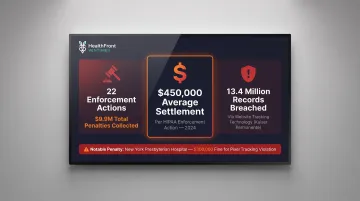
Healthcare marketing in 2026 operates under intensifying regulatory pressure that has transformed from theoretical risk into documented financial consequence. The Office for Civil Rights (OCR) closed 22 HIPAA enforcement actions in 2024, collecting more than $9.9 million in penalties — with the average settlement reaching approximately $450,000. Even more concerning for marketing teams, state-level enforcement has specifically targeted website tracking technologies: New York Presbyterian Hospital faced a $300,000 penalty from the New York Attorney General exclusively for improper use of pixels and tracking tools, while Kaiser Foundation Health Plan reported a 13.4 million-record breach caused by website tracking technologies.
For healthcare organizations — especially rural providers operating with lean teams and limited IT infrastructure — the stakes extend far beyond regulatory fines. A non-compliant analytics tool creates immediate exposure to seven-figure penalties. A compliant one unlocks measurable campaign ROI, patient acquisition insights, and channel attribution without putting patient data at risk.
The challenge is especially pressing for resource-constrained organizations. Only 48% of rural hospitals met all four EHR interoperability domains in 2021, compared to 62% nationally, and workforce shortages continue to strain health IT capacity.
For these organizations, purpose-built or outsourced compliance solutions that eliminate internal IT overhead aren't just preferable — they're often the only viable path forward. This guide breaks down the top HIPAA-compliant healthcare marketing analytics tools available in 2026, what to look for in each, and how to evaluate them against your organization's specific constraints.
Key Takeaways
- HIPAA-compliant analytics require a Business Associate Agreement (BAA), data encryption, and no PHI sharing with third-party ad networks
- Google Analytics 4 is not HIPAA-compliant and cannot be used where patient health intent can be inferred
- The five best tools for 2026 are Freshpaint, Piwik PRO, Improvado, Matomo, and CallRail
- Choose based on BAA availability, PHI filtering, attribution features, and organizational fit
- Rural organizations should prioritize managed solutions that outsource data infrastructure
What HIPAA-Compliant Analytics Actually Means for Healthcare Marketers
HIPAA-compliant analytics means using platforms that handle Protected Health Information (PHI) — including IP addresses, URL parameters, form submissions, and behavioural signals linked to health conditions — under legal safeguards that standard marketing tools simply don't provide.
Why Google Analytics 4 Fails the HIPAA Standard:
Google explicitly states it "does not offer Business Associate Agreements in connection with this service" and instructs healthcare entities not to use GA4 on HIPAA-covered pages. Google's own support documentation warns: "Customers who are subject to HIPAA must not use Google Analytics in any way that implicates Google's access to, or collection of, PHI." The platform routes data through Google's advertising infrastructure by design, creating automatic compliance exposure in healthcare contexts.
What is a Business Associate Agreement (BAA)?
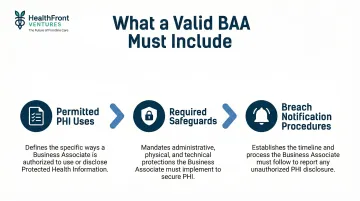
A BAA is a legally binding contract required under HIPAA between a covered healthcare entity and any vendor that may access, process, or store PHI. Per HHS guidance, a valid BAA must:
- Describe permitted uses of PHI
- Require appropriate safeguards to prevent unauthorized use
- Establish data breach notification procedures
Without a signed BAA covering all data processing activities, deploying any analytics platform that touches patient data creates immediate regulatory exposure.
The tools evaluated below are selected for healthcare marketing teams that need to measure campaign performance, patient acquisition, and channel attribution without compliance risk. For rural healthcare organizations building data infrastructure for the first time, purpose-built or outsourced solutions are especially practical — they remove the need to hire dedicated data engineering teams while staying fully within HIPAA requirements.
Top 5 HIPAA-Compliant Healthcare Marketing Analytics Tools in 2026
These tools were selected based on BAA availability, PHI safeguard design, marketing analytics functionality, and suitability for healthcare organizations of varying size and technical capacity.
Freshpaint
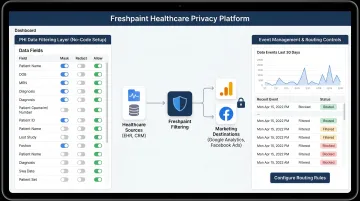
Freshpaint is a healthcare-first customer data platform (CDP) purpose-built to act as a privacy layer between user behaviour data and downstream marketing tools — allowing teams to track events without sending raw PHI to platforms like Google Analytics, Meta Ads, or CRMs.
Key Differentiator: An automatic PHI-filtering layer blocks sensitive data from reaching non-compliant destinations. The platform offers visual event management for no-code setup, BAA availability, and compatibility with 53+ marketing and analytics destinations — making it the only tool in this list designed for healthcare privacy compliance.
Columbus Regional Health adopted Freshpaint after HHS guidance forced them to shut off all non-compliant tracking. Andrew Laker, their Web Applications Developer, described the initial guidance as feeling like "a death in the family" for their marketing team. Freshpaint allowed them to restore marketing measurement while maintaining full HIPAA compliance.
| Aspect | Details |
|---|---|
| Key Features | Auto and manual event tracking, PHI data blocking layer, 53+ integrations, Visual Event Manager for no-code setup, HIPAA Mode with enforced allowlists |
| HIPAA Compliance Mechanism | Signed BAA included on Compliance plan; PHI filtered before data reaches third-party tools; encryption in transit and at rest; access controls and audit logs |
| Best For / Pricing | Healthcare marketing teams using multiple analytics and ad platforms who need a compliant data gateway; custom pricing by tier (Compliance, Enterprise, Elite) |
Piwik PRO
Piwik PRO is a privacy-first analytics and tag management platform originally built for regulated industries, offering full data ownership — data is processed on infrastructure the customer controls and never shared with advertising networks.
For healthcare specifically, it offers:
- Customizable BAA and zero commercial stake in patient behavioral data
- Service line conversion tracking and multi-location analytics
- Patient portal measurement in authenticated environments
- Private cloud or on-premises deployment (SOC 2 Type II and ISO 27001 certified)
Shepherd Center, an Atlanta-based neurorehabilitation hospital, replaced Google Analytics with Piwik PRO after the December 2022 HHS guidance. Results included a 40% increase in online patient referrals, 215% increase in referral page views, and 79% decrease in bounce rates. Chris Walker, Director of Digital Strategy, noted: "We're a small in-house team, so not having to onboard into a new platform that would require a very steep learning curve was very helpful."
| Aspect | Details |
|---|---|
| Key Features | Web analytics, tag manager, consent manager, customer data platform, multi-property and service line reporting, portal engagement measurement, 98% attribution accuracy |
| HIPAA Compliance Mechanism | Customizable BAA; private cloud or on-premises hosting on HIPAA-compliant Azure; full data ownership; no third-party ad network data sharing; role-based access and audit logging |
| Best For / Pricing | Hospitals, health systems, and multi-location providers needing full-stack compliant analytics with complete data ownership; custom enterprise pricing |
Improvado
Improvado is a HIPAA-compliant marketing intelligence platform that centralizes data from 500+ sources — including other HIPAA-compliant tools — applies automated transformations, and delivers analysis-ready data to BI tools or data warehouses without manual pipelines.
Cross-channel attribution, AI-powered campaign monitoring, and data warehouse-native analytics ensure no data leaves the controlled environment. Improvado's SOC 2 Type II certification (completed "with no findings") and BAA availability across all tiers make it suitable for organizations requiring enterprise-grade compliance infrastructure.
Practical use cases include:
- Service line ROI analysis across campaigns
- Multi-location attribution reporting
- Native integration with Tableau and Looker, eliminating manual pipeline builds
| Aspect | Details |
|---|---|
| Key Features | 500+ data source connectors, no-code data transformation, AI-powered Marketing Data Governance, BI tool integrations (Tableau, Looker), data warehouse-native intelligence |
| HIPAA Compliance Mechanism | BAA available on all tiers; robust encryption in transit and at rest; role-based access controls; regular audits and breach notification procedures; secure data disposal |
| Best For / Pricing | Healthcare organizations centralizing marketing data from many sources and needing automated cross-channel attribution; custom pricing based on data volume |
Matomo
Matomo is an open-source web analytics platform functioning as a privacy-first GA4 alternative — offering traffic analysis, event tracking, heatmaps, funnels, and A/B testing — with a self-hosted deployment option that gives organizations complete control over data storage and access.
Key Advantage: The self-hosted version is free and stores all data on the organization's own servers, making it attractive for budget-conscious or technically capable healthcare organizations. However, this approach shifts the full compliance, security, and maintenance burden to internal IT staff. Matomo does not natively sign BAAs, but self-hosted deployments can meet HIPAA standards through internal infrastructure safeguards; cloud-hosted compliance depends on hosting provider arrangements.
For rural organizations where only 48% of hospitals achieve full EHR interoperability and workforce constraints are a primary HIT challenge, the self-hosted option may not be viable despite zero software licensing costs.
| Aspect | Details |
|---|---|
| Key Features | Web analytics, session recording, heatmaps, A/B testing, tag management, real-time reporting, open-source codebase, 100+ paid plugins available |
| HIPAA Compliance Mechanism | Self-hosted: full data ownership, no third-party access, encryption configurable at server level; cloud-hosted: compliance depends on hosting provider and BAA availability |
| Best For / Pricing | Technically resourced organizations wanting full control and lowest software cost; self-hosted version is free; cloud-hosted starts at approximately $29/month |
CallRail
CallRail is a call tracking and attribution platform that captures inbound call data, attributes phone leads to specific marketing channels or campaigns, and analyzes conversation content — filling a critical gap for healthcare providers where phone calls remain a primary patient acquisition channel.
CallRail is the only tool in this list purpose-built for call-based patient acquisition measurement. It offers a HIPAA-compliant plan with BAA, voicemail and call recording redaction using machine learning (95% accuracy rate), role-based access, and dynamic number insertion for accurate channel attribution.
CallRail enables PII redaction by default for healthcare accounts, automatically removing sensitive information — including medical conditions, diagnoses, medications, treatments, and procedures — from transcripts and recordings. For rural providers and specialty practices where phone volume drives patient acquisition, this capability is difficult to replicate with general-purpose analytics tools.
| Aspect | Details |
|---|---|
| Key Features | Dynamic number insertion, call and form tracking, conversation intelligence with 95% redaction accuracy, CRM and ad platform integrations, automated lead attribution |
| HIPAA Compliance Mechanism | BAA available on all Healthcare Plans; voice and transcript redaction for medical information; encryption at rest and in transit; audit logs; HIPAA features must be explicitly activated |
| Best For / Pricing | Healthcare providers with high call volume (clinics, specialty practices, rural providers) needing HIPAA-safe call attribution; Healthcare Plans start at $150/month |
How We Chose These Tools
Tools were assessed on four non-negotiable compliance criteria — BAA availability, PHI handling architecture, data residency controls, and encryption standards — plus marketing functionality including attribution capability, integration breadth, reporting depth, and ease of use for non-technical teams.
Common Selection Mistakes to Avoid:
- Enterprise-grade tools are not automatically HIPAA-compliant — brand reputation doesn't equal compliance
- HIPAA features often sit behind specific plan tiers or require explicit activation — CallRail's Healthcare Plans are a prime example
- Downstream integrations must also be BAA-covered; one uncovered connection breaks the entire compliance chain
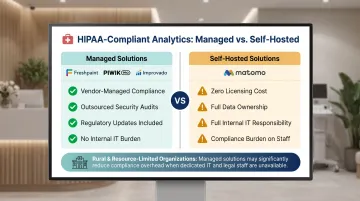
For rural and resource-limited healthcare organizations, one additional criterion matters: whether compliance infrastructure is outsourced and managed versus requiring in-house implementation. The self-hosted Matomo option eliminates vendor BAA requirements but transfers the full compliance, security, and maintenance burden to internal IT staff.
That tradeoff is significant when workforce shortages already strain health IT capacity.
Managed solutions like Freshpaint, Piwik PRO, and Improvado eliminate costly in-house builds by providing outsourced data infrastructure with vendor-managed compliance certification, security audits, and ongoing regulatory updates — the same operational logic that makes outsourced analytics infrastructure a practical fit for rural organizations with limited internal IT staff.
Frequently Asked Questions
Is Google Analytics HIPAA-compliant for healthcare marketing?
No. Google Analytics is not HIPAA-compliant because Google does not offer a Business Associate Agreement for GA, and Google explicitly warns healthcare organizations not to use GA on pages where PHI may be collected — including condition-specific pages, appointment booking flows, and patient portals.
What is a Business Associate Agreement (BAA) and why is it required for analytics tools?
A BAA is a legally binding contract required under HIPAA between a covered healthcare entity and any vendor that may access, process, or store PHI. It defines permitted uses of PHI, requires safeguards to prevent unauthorized disclosure, and establishes breach notification procedures. No analytics platform that touches patient data can be legally deployed without one.
What types of data count as PHI in healthcare marketing analytics?
PHI in analytics goes beyond names and medical records. It includes IP addresses tied to health-condition page visits, URL parameters revealing service line or physician pages, appointment form entries, and click IDs like GCLID passed through ad platforms. Per the HHS OCR tracking technologies bulletin, device IDs and advertising IDs also qualify as PHI when linked to healthcare interactions.
What should healthcare organizations look for when evaluating HIPAA-compliant analytics vendors?
Key checklist items include: BAA that covers all data processing activities, data residency and hosting controls, encryption in transit and at rest, zero data sharing with third-party ad networks, and marketing functionality including attribution modelling, custom reporting, and integration compatibility with existing martech stacks.
Can rural or small healthcare organizations realistically afford HIPAA-compliant analytics tools?
Yes. Options exist across budgets — Matomo's self-hosted version is free (though it requires internal IT resources), while managed solutions like Freshpaint, Piwik PRO, and CallRail offer outsourced compliance infrastructure starting at $30–$150/month, eliminating costly in-house builds and making them viable even for lean teams when total cost of ownership is calculated.
How does HIPAA-compliant analytics differ from standard web analytics?
HIPAA-compliant analytics tools are architected to prevent PHI from entering non-compliant systems through data filtering, server-side processing, and strict access controls. Standard tools like GA4 collect and route data through advertising infrastructure by design, creating automatic compliance exposure in healthcare contexts where patient health intent can be inferred from page visits or form interactions.
Conclusion
Choosing a HIPAA-compliant analytics tool shapes what campaign questions a healthcare marketing team can answer, how quickly they can prove ROI, and how resilient the organization is to regulatory scrutiny — in an enforcement environment where the average penalty now reaches $450,000.
Assess tools against your specific use case before committing — a rural clinic with high call volume has different needs than a multi-location hospital system. Key selection criteria beyond feature lists:
- Use case fit: CallRail suits call-heavy rural clinics; Piwik PRO suits multi-site service line attribution
- Total cost of ownership: Include BAA terms, support tiers, and scaling costs
- Team capacity: Matomo's self-hosted option carries zero licensing costs but places full compliance burden internally
- Managed solutions: Eliminate infrastructure overhead while maintaining audit-ready compliance
For rural healthcare organizations, compliant marketing analytics is one piece of a larger data infrastructure challenge. HealthFront Ventures' HealthFront Baseline™ — launching Q1 2026 — addresses the broader gap: AI-native workforce data warehouses with pre-built FY25 baseline metrics for rural HCP retention and recruitment.
Like managed HIPAA-compliant analytics tools, this outsourced approach removes the burden of custom infrastructure builds — so rural healthcare leaders can focus on decisions, not data pipelines.