Introduction
Rural and underserved health systems operate with fragmented data environments that make tracking physician and advanced practice provider (NP/PA) performance exceptionally difficult. Unlike their urban counterparts, these organizations face compounded challenges: limited IT staff, disconnected EHR systems, and persistent workforce gaps that complicate even basic performance measurement. Research from Arcadia shows that 47% of healthcare data remains underutilized in clinical and business decision-making — a problem particularly acute in rural settings where every data point counts.
That underutilization gap is exactly what healthcare analytics tools are designed to close. The right platform helps organizations measure clinical quality, workforce productivity, and value-based care outcomes from a unified data environment. For rural organizations specifically, choosing a tool that delivers actionable insights without requiring extensive IT overhead is a decision with direct consequences for workforce retention, care quality, and long-term financial viability.
Key Takeaways
- Healthcare analytics tools unify clinical and workforce data to measure quality, productivity, and value-based care performance without requiring separate reporting systems
- Health Catalyst, Clarify Health, Arcadia, Innovaccer, and Power BI serve different organizational scales and levels of existing data infrastructure
- Track what matters: readmission rates, care variation, quality scores, provider productivity, and workforce retention
- Rural organizations need outsourced data infrastructure, pre-built models, and minimal technical overhead to succeed
- Evaluate tools on EHR integration capability, HIPAA compliance, AI readiness, and alignment with value-based care reporting requirements
Overview of Healthcare Analytics in Provider Performance Tracking
Healthcare analytics for provider performance tracking goes beyond general clinical business intelligence. These platforms specifically measure how individual providers — physicians, NPs, and PAs — perform against quality benchmarks, utilization targets, and patient outcomes goals. The distinction matters: tracking system-wide trends is one thing; attributing performance to specific clinicians and care teams is another entirely.
The healthcare analytics market is experiencing rapid growth. Grand View Research estimates the global market at $52.98 billion in 2024, projecting it will reach $198.79 billion by 2033 — a compound annual growth rate of 14.85%. Yet many organizations still struggle to turn that data into actionable insight.
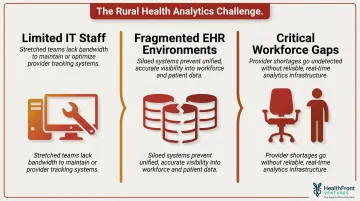
Rural healthcare organizations face distinct, amplified challenges. HRSA projects a national shortage of 141,160 FTE physicians by 2038, with rural areas disproportionately affected. Three compounding factors make this particularly acute:
- Limited IT staff with capacity to build or maintain custom analytics infrastructure
- Fragmented EHR environments that obstruct clean, attributable provider data
- Critical workforce gaps that leave no margin for delayed retention signals
For these organizations, purpose-built or outsourced analytics isn't a luxury — it's how provider shortages get caught before they become crises.
Top Healthcare Analytics Tools for Provider Performance Tracking
These tools were selected based on their ability to track provider-level performance, integrate with clinical and workforce data sources, support compliance requirements, and deliver actionable insights at scale.
Health Catalyst
Health Catalyst is a healthcare-specific analytics and data platform focused on clinical, operational, and financial outcomes for health systems. The company positions its cloud-based, open-platform Data Operating System (DOS) as the successor to legacy on-premises data warehouses.
For provider performance tracking, Health Catalyst delivers:
- Pre-built analytics apps for clinical quality measurement, population health, and workforce efficiency
- An enterprise data warehouse that unifies EHR, claims, and operational data across complex, multi-source environments
- Real-time integration and machine learning use cases, including sepsis early warning
- Self-service analytics that let clinical teams drill into performance data without waiting on IT
| Feature Category | Details |
|---|---|
| Key Features | Pre-built analytics apps for quality, outcomes, and workforce efficiency; enterprise data warehouse unifying EHR, claims, and operational data; self-service analytics and AI-driven predictive modeling |
| Best For | Mid-to-large health systems tracking provider performance across multiple service lines and value-based care contracts |
| Pricing | Custom; contact for a demo |
Clarify Health
Clarify Health is an enterprise analytics platform recognized for provider performance tracking and value-based care enablement. The company's Atlas platform maps patient journeys and delivers insights for providers and payers, including benchmarking tools specifically designed for network quality management.
The key differentiator: Clarify's proprietary Blue Diamonds methodology uses machine learning and generalized linear models to compute case-mix adjusted expected performance values based on each provider's actual patient panel, comorbidities, and social determinants of health. This produces fair, dynamic benchmarking with drill-through transparency.
Clarify's CMS Qualified Entity status grants access to 100% Medicare fee-for-service data for provider-level insights — critical for organizations managing network quality under value-based care and identifying performance variability at the individual provider level.
| Feature Category | Details |
|---|---|
| Key Features | Case-mix adjusted performance benchmarks; Atlas platform for patient journey mapping; non-public analyses using Medicare data; AI-driven predictions at the provider level |
| Best For | Health plans and providers needing deep, provider-level performance benchmarking and value-based care transformation support |
| Pricing | Custom; contact sales for details |
Arcadia
Arcadia is a cloud-based healthcare data platform recognized five times by KLAS Research, connecting thousands of clinical and claims data sources for comprehensive analytics and workflow execution. The platform serves ACOs, CINs, and provider organizations managing value-based care contracts.
Where it excels: Arcadia closes the gap between data insight and clinical action through AI-powered workflows, network optimization tools, and referral analytics. The Network Modeler supports healthcare network design using cost and quality insights, enabling organizations to benchmark provider performance and build high-performing networks.
That tight integration between analytics and operational workflows makes Arcadia the stronger choice for organizations that need insights tied directly to care management activities — not just static reports.
| Feature Category | Details |
|---|---|
| Key Features | AI-powered care management and agentic AI capabilities; Network Modeler for provider performance benchmarking; quality and risk performance measurement; conversational analytics |
| Best For | Organizations managing large, complex provider networks under value-based care arrangements who need analytics tied directly to operational workflows |
| Pricing | Custom; request a demo via Arcadia's website |
Innovaccer
Innovaccer is a healthcare data platform built around a unified patient record and population health management, used by provider organizations for value-based care performance tracking. The platform emphasizes real-time performance tracking across cost, quality, and utilization.
What sets it apart: Interoperability via HL7 and FHIR standards, advanced risk stratification, and VBC-aligned performance reporting make Innovaccer well-suited for provider groups that need to demonstrate quality and cost performance to payers. The unified patient record aggregates fragmented data sources into a single view, enabling accurate attribution of outcomes to individual providers and teams.
Innovaccer earned Best in KLAS recognition for its CRM solution and scored highly in Data and Analytics Platforms categories.
| Feature Category | Details |
|---|---|
| Key Features | Unified patient record with advanced risk stratification; VBC performance reporting and care gap monitoring; interoperability via HL7, FHIR, and APIs |
| Best For | Provider organizations and ACOs tracking performance under value-based care and population health management programs |
| Pricing | Custom; pricing not publicly disclosed |
Microsoft Power BI (with EHR Integration)
Power BI is a widely adopted, cost-accessible business intelligence platform that, when connected to EHR and claims data via API or export, enables provider performance dashboards for organizations without enterprise-grade analytics infrastructure.
The appeal for smaller organizations: seamless Microsoft ecosystem integration (Azure, Dataverse), customizable provider performance templates, and row-level security for role-based access control — all at a substantially lower cost than purpose-built healthcare platforms.
The trade-off is real, though. Power BI requires more internal configuration and lacks pre-built healthcare data models, quality measure libraries, and clinical workflows that enterprise tools provide out of the box.
| Feature Category | Details |
|---|---|
| Key Features | Customizable provider performance dashboards; seamless Microsoft Azure and EHR API integration; row-level security for role-based access; affordable tiered pricing |
| Best For | Small to mid-size healthcare organizations and rural health systems seeking cost-effective, customizable provider performance reporting without enterprise licensing costs |
| Pricing | Power BI Pro: ~$14/user/month; Power BI Premium Per User: ~$28/user/month (as an add-on to Pro, per Microsoft pricing) |
Key Provider Performance Metrics These Tools Should Track
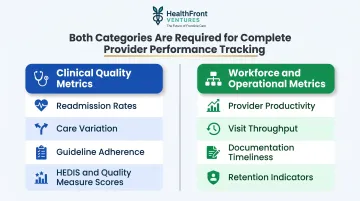
Provider performance metrics fall into two primary categories: clinical quality metrics and workforce/operational metrics. Tracking only one without the other leaves critical blind spots — especially for organizations managing both care quality and provider supply.
Clinical quality metrics include:
- Readmission rates
- Care variation (deviation from evidence-based guidelines)
- Guideline adherence
- HEDIS and quality measure scores
Workforce and operational metrics include:
- Provider productivity (visits per day, panel sizes)
- Visit throughput
- Documentation timeliness
- Retention indicators
These standard categories cover most use cases — but for rural healthcare organizations, general BI platforms often miss the metrics that matter most.
NP/PA utilization rates, provider-to-patient ratios, and rural county-level quality benchmarks require purpose-specific tracking that most off-the-shelf tools don't support natively. Rural areas are designated as Health Professional Shortage Areas (HPSAs) at significantly higher rates than urban counties, making workforce supply and retention tracking foundational — not optional.
Workforce tracking needs connect directly to value-based care obligations. MIPS, HEDIS, and ACO quality reporting all require provider-level data tied to cost performance and risk stratification — and organizations with workforce gaps face compounded difficulty meeting those benchmarks. Analytics platforms that integrate workforce metrics alongside CMS quality frameworks are better positioned to support both compliance and improvement goals.
How We Chose the Best Healthcare Analytics Tools for Provider Performance
These tools were evaluated based on their ability to track individual and population-level provider performance, support HIPAA-compliant data environments, integrate with common EHR and claims systems, and deliver usable findings for clinical and operational decisions — not just static reports.
Common mistakes organizations make when selecting analytics tools:
- Selecting by brand name rather than fit — enterprise platforms built for multi-hospital systems often carry licensing costs and technical complexity that overwhelm smaller or rural organizations.
- Skipping integration validation — clinical data integration gaps around HL7/FHIR compatibility and data normalization remain widespread, and tools chosen without that vetting routinely require costly custom builds.
- Defaulting to general BI tools like Power BI or Tableau — without pre-built quality measure libraries and provider attribution logic, organizations spend months recreating what purpose-built platforms include by default.
The tools reviewed here were chosen specifically to avoid these failure modes — prioritizing proven EHR integration, healthcare-native data models, and measurable output over feature-count or vendor reputation.
Conclusion
The right healthcare analytics tool for provider performance tracking must align with your organization's care model, data infrastructure maturity, and workforce reality, not just the tool's brand or feature list. Mid-to-large health systems managing multiple service lines and value-based care contracts may require the depth of Health Catalyst or Arcadia. Organizations needing provider-level benchmarking and case-mix adjustment should evaluate Clarify Health. Smaller organizations or those with limited budgets can start with Power BI, provided they have the internal capacity to configure dashboards and connect data sources.
Evaluate tools on scalability, EHR integration, and whether the platform can surface workforce-level insights — particularly for rural organizations managing NP/PA recruitment and retention.
The most sophisticated analytics engine is useless if it can't answer what your leadership team is actually asking:
- Which providers are at risk of leaving?
- Where are quality gaps emerging?
- How do our rural county outcomes compare to state and national benchmarks?
One category of tool worth evaluating on those criteria: purpose-built data infrastructure for rural workforce tracking. HealthFront Baseline™ by HealthFront Ventures delivers a ready-to-deploy data infrastructure with four quantitative workforce metrics and a rural county quality measure — built specifically for organizations that lack the internal capacity to construct this infrastructure from scratch.
Frequently Asked Questions
What are the best tools for healthcare analytics?
Top platforms include Health Catalyst, Clarify Health, Arcadia, Innovaccer, and Power BI. The right tool depends on organizational size, use case (clinical quality vs. workforce vs. revenue cycle), and whether you need a purpose-built healthcare platform or a configurable BI solution.
Which tool is widely used for real-time big data analytics?
Arcadia, Health Catalyst, and Innovaccer are widely used, processing millions of clinical and claims records with live performance dashboards. Health Catalyst's DOS platform specifically supports real-time integration and data movement alongside batch loads.
Which data visualization tool is commonly used for real-time analytics?
Microsoft Power BI and Tableau are the most widely adopted data visualization tools for real-time analytics, with Power BI particularly prevalent in healthcare organizations already using Microsoft Azure infrastructure. Purpose-built healthcare platforms like Clarify Health and Arcadia include native real-time visualization capabilities.
What metrics should healthcare providers track with analytics tools?
Core metrics include clinical quality (readmission rates, HEDIS scores), operational performance (visit throughput, provider productivity), and workforce data (retention rates, provider-to-patient ratios). Rural organizations should also monitor county-level quality benchmarks and rural workforce supply to track HPSA designation risk.
How do healthcare analytics tools support value-based care performance reporting?
Arcadia, Innovaccer, and Health Catalyst align provider data with VBC contract requirements — covering MIPS, HEDIS, and ACO benchmarks — while automating measure calculations and cost performance tracking required by CMS and payer programs.
What should rural healthcare organizations specifically look for in a provider analytics platform?
Look for outsourced or pre-built data infrastructure to avoid costly custom builds, rural-specific workforce metrics, FHIR/EHR interoperability, and platforms that function effectively with limited internal IT support. AI-native solutions built specifically for rural HCP workforce data, like HealthFront Baseline™, address these requirements without requiring significant internal data engineering resources.