Introduction
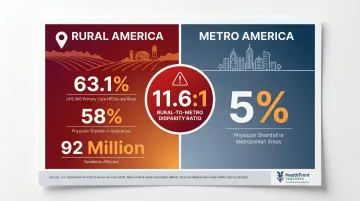
Healthcare organizations face unprecedented workforce pressure. According to HRSA workforce projections, the US faces a shortage of 141,160 physicians by 2038 — with rural areas hit hardest, projecting a 58% physician shortfall compared to just 5% in metro areas. Separately, the 2024 NSI National Health Care Retention Report puts average hospital RN turnover costs at $3.85M–$5.65M annually, with each departing nurse costing $61,110 to replace.
For rural facilities already operating with critically low provider-to-patient ratios, that math is unforgiving. A single unfilled shift can mean turning away patients or pushing already strained staff toward burnout.
Healthcare workforce planning tools are evolving from reactive scheduling fixes to proactive, data-driven strategy platforms. The best systems now combine shift management, demand forecasting, credential tracking, and retention planning—addressing not just when staff work, but whether they stay.
Choosing the right platform can mean the difference between plugging today's gap and solving next year's shortage before it starts.
Key Takeaways
- Workforce planning tools reduce overtime costs, fill shifts faster, and improve retention through predictive analytics and automation
- Top platforms integrate scheduling, compliance tracking, and forecasting with existing HR/EHR systems
- Rural organizations need tools that account for NP/PA workforce dynamics and county-level shortage data
- Five standout platforms covered: SAP SuccessFactors, Workday Adaptive Planning, Andgo, Shiftboard, and symplr
- Tool selection should match organizational size, data infrastructure, and workforce profile—not brand recognition
What Is a Healthcare Workforce Planning Tool?
A healthcare workforce planning tool is any software, system, or methodology that helps organizations anticipate, manage, and optimize clinical and administrative staffing needs. These platforms address scheduling, forecasting, compliance, and talent management—functions that directly impact patient care quality and operational cost control.
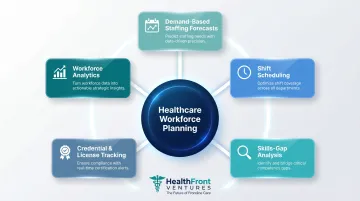
Most tools cover five core functional areas:
- Demand-based staffing forecasts — predicting volume-driven labor needs
- Shift scheduling — automating coverage and managing real-time gaps
- Skills-gap analysis — identifying training or hiring needs
- Credential and license tracking — ensuring provider qualifications remain current
- Workforce analytics — measuring productivity, turnover, and cost efficiency
The healthcare workforce management system market reached $2.38 billion in 2025 and is projected to hit $4.74 billion by 2030—a 14.9% annual growth rate signaling rapid adoption across hospitals, long-term care facilities, and multi-site health systems.
AI is driving much of that adoption. Predictive scheduling automates shift assignment based on historical patterns, while real-time analytics flag coverage risks before they become crises. One peer-reviewed study found that AI-based scheduling explained 27% of variance in nurse job satisfaction—a retention factor worth approximately $289,000 per hospital per 1% turnover reduction.
The five tools below cover this full spectrum. Each serves a different organizational context, so understanding their core strengths helps narrow the right fit for your staffing challenges.
Top Healthcare Workforce Planning Tools for Optimizing Staffing
These platforms were selected for proven healthcare application, workforce planning depth, scalability, integration capabilities, and market trust. Not every tool fits every organization—use case alignment determines success.
SAP SuccessFactors
A cloud-based HR and workforce management platform used by large health systems globally, SAP SuccessFactors covers the full employee lifecycle: recruitment, onboarding, performance management, and labor forecasting. The platform partners with WorkForce Software to deliver healthcare-specific scheduling and compliance functionality.
Its advanced analytics dashboards generate predictive staffing forecasts tied to patient volume trends, and its scheduling engine tests millions of combinations to optimize coverage while controlling overtime exposure. For rural health systems with limited administrative staff, the self-service and compliance automation features reduce manual coordination overhead significantly.
| Key Features | Predictive workforce analytics, labor forecasting, talent management, employee self-service scheduling, compliance monitoring for union and labor law requirements |
| Best Fit For | Large health systems and regional hospitals requiring enterprise-grade HR infrastructure with integrated financial planning |
| Pricing/Access | Contact-for-quote; SAP Enterprise Support embedded in cloud solutions at no additional fee. Request demo |
Singapore's National University Health System deployed SuccessFactors using a modular rollout—a practical approach for organizations that can't afford system-wide disruption during implementation.
Workday Adaptive Planning
A cloud-based planning and forecasting platform designed for organizations of all sizes, Workday Adaptive Planning is widely adopted in healthcare for scenario modeling, role-based workforce planning, and budget-linked staffing projections. The platform excels at connecting workforce decisions to financial outcomes.
Its what-if scenario tools let administrators model hiring needs against variables like patient volume shifts, new service line launches, or NP/PA turnover rates. This makes it particularly useful for rural health programs modeling workforce gaps ahead of grant funding cycles or state RHT initiative rollouts.
| Key Features | What-if scenario modeling, role-based planning, turnover and pay equity analytics, collaborative planning workflows, FTE planning with retention/compensation modeling |
| Best Fit For | Healthcare CFOs and HR leaders needing integrated financial and workforce planning with unlimited personal scenario testing |
| Pricing/Access | Contact-for-quote; 30-day free trial available with guided walkthroughs. Available via AWS Marketplace |
M Health Fairview and Orion Health use Workday Adaptive Planning for financial planning and data value optimization.
Andgo
An intelligent automation platform purpose-built for healthcare, Andgo specializes in automated shift filling, absence reporting, and vacation scheduling—helping organizations eliminate last-minute coverage gaps and reduce reliance on agency staff. The platform handles high-volume shift operations at scale.
Andgo instantly notifies eligible employees of open shifts via SMS and IVR (interactive voice response), cutting manual fill time from 28 minutes to 3 minutes. Saskatchewan Health Authority doubled shift capacity—from 7,500 to 15,000 shifts per week—while managing 10,000+ staff across 100+ communities. That scale mirrors what multi-site rural health networks face when coordinating coverage across dispersed locations.
| Key Features | Automated shift notifications, IVR absence reporting (Quick Dial), shift prebooking (Smart Call), broadcast communications (Inform), vacation mapping with responsive scheduling interface |
| Best Fit For | Mid-to-large healthcare facilities with complex shift structures, high call-out frequency, and multi-site operations requiring rapid coverage response |
| Pricing/Access | Contact-for-quote; book demo for virtual tour. Integrates with UKG Pro Workforce Management |
Shiftboard
An all-in-one workforce management solution built for industries with complex staffing demands, Shiftboard helps healthcare organizations automate scheduling, manage coverage gaps in real time, and control overtime costs through smart shift assignment logic. The platform prioritizes employee engagement alongside operational efficiency.
Retention is where Shiftboard earns attention. Its flexible scheduling model accommodates shift preferences and enables self-service trading, reducing burnout. Clients report 16% lower turnover and 86% higher worker satisfaction—outcomes that matter acutely in rural settings where replacing a lost NP or PA takes months, not weeks.
| Key Features | Auto-fill shift scheduling with configurable automation, overtime/fatigue limit controls that auto-block violations, mobile self-service app for shift volunteering and trading, multi-location coverage visibility with SMS/email/voice notifications |
| Best Fit For | Healthcare organizations managing large hourly clinical workforces across multiple locations with union contracts or fatigue rule compliance requirements |
| Pricing/Access | Subscription-based; contact-for-quote. ROI calculator available. Reported outcomes include 88% higher shift coverage and 21% lower labor costs |
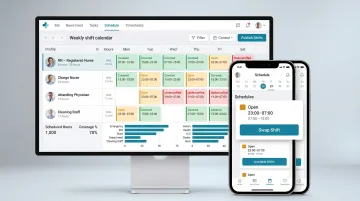
Wellness Corporate Solutions uses Shiftboard to schedule healthcare workers for events, providing communication tools for candidates, recruiters, and clients.
symplr
An enterprise healthcare operations platform, symplr integrates workforce management with credentialing and compliance—giving clinical and HR teams real-time visibility into staff qualifications, scheduling, and regulatory standing from a single cloud-based system. Ranked #1 by Black Book for credentialing software in 2024 and 2025.
For rural healthcare organizations, credentialing is often the hidden bottleneck: a lapsed NP or PA credential can pull a provider from practice entirely. symplr's library of 9,600+ delineated privileges with embedded ICD/CPT codes automates primary source verification—keeping multi-provider clinics compliant across state scope-of-practice rules without a dedicated credentialing team.
| Key Features | Credentialing and compliance tracking with automated primary source verification, real-time scheduling (Smart Square) with demand forecasting, workforce analytics, self-service tools for clinical and non-clinical staff, integrated OPPE/FPPE |
| Best Fit For | Healthcare organizations prioritizing compliance-first workforce management, including rural multi-provider clinics managing scope-of-practice regulations across states |
| Pricing/Access | Contact-for-quote; request demo. Used by 9 out of 10 hospitals and health systems nationwide |
symplr clients report 60% reduction in credentialing turnaround times, 50% faster committee review time, and one organization avoided needing 3 additional FTEs by implementing the platform.
How We Chose These Healthcare Workforce Planning Tools
We assessed tools on healthcare-specific functionality, scalability across organization sizes, real-world user feedback, integration with existing EHR and HR systems, and applicability to both urban and rural care settings. Selecting based on brand recognition alone is a common mistake. Alignment with operational needs matters more than market presence.
Evaluation criteria prioritized:
- Automated credentialing verification, license tracking, and scope-of-practice compliance
- AI-driven scheduling with fatigue rule enforcement and self-service shift management
- Demand forecasting, scenario modeling, and turnover risk detection
- Training resources, integration tooling, and deployment support programs
- Multi-site scheduling with NP/PA credential tracking and county-level data compatibility for rural and underserved settings
These criteria cover the operational layer well. For rural-serving organizations, though, a foundational data problem sits underneath all of it: most planning tools lack county-level provider metrics needed to establish rural workforce baselines.
Of 8,466 primary care HPSAs nationwide, 63.1% are in rural areas, affecting 92 million residents. Rural counties face an 11.6:1 disparity ratio in physician shortage severity compared to metro areas. Without baseline county-level data, even the best scheduling tools are planning in the dark.
For organizations operating in rural communities, data infrastructure capturing rural county-level MD and NP/PA workforce metrics is a prerequisite — not a nice-to-have. HealthFront Baseline™ addresses this specific gap, providing AI-native HCP workforce data with rural county quality measures that scheduling platforms alone do not supply.
Conclusion
The right healthcare workforce planning tool depends on your organization's specific challenges—whether that's reducing overtime costs, filling shifts faster, managing credentialing compliance, or building long-term retention strategies for rural providers.
Evaluate tools not just on feature lists but on scalability, implementation support, data integration capabilities, and alignment with your patient population and workforce profile. A metro health system's needs differ fundamentally from a rural multi-site clinic managing NP scope-of-practice across state lines.
That data infrastructure gap is where rural-focused organizations often need to start. HealthFront Baseline™ provides an AI-native workforce data layer for MDs and NPs/PAs—including rural county quality measures—that most planning tools assume you already have but don't supply on their own.
Rural healthcare organizations and state-level health programs can learn more at HealthFront Ventures or connect with the team directly through their contact form.
Frequently Asked Questions
What is a healthcare workforce planning tool?
A healthcare workforce planning tool is software or a structured methodology that helps organizations forecast staffing needs, manage schedules, track credentials, and close skills gaps—typically combining scheduling automation, compliance tracking, and workforce analytics in one platform.
How do workforce planning tools help reduce clinician turnover?
Tools with flexible scheduling, self-service shift management, and performance tracking improve staff satisfaction while giving administrators early visibility into disengagement signals. In documented cases, AI-based scheduling has measurably improved nurse job satisfaction—and higher satisfaction consistently predicts lower turnover.
What features should rural healthcare organizations prioritize in a workforce planning tool?
Rural organizations should prioritize credential and license tracking for NPs and PAs (including scope-of-practice compliance across state lines), rural-specific workforce benchmarks, multi-site scheduling support, and integration with state health workforce planning data sources.
How does AI improve healthcare staffing optimization?
AI enables predictive demand forecasting, automated shift matching, and real-time gap detection—reducing manual scheduling effort and improving coverage accuracy. Nebraska Medicine achieved a nearly 50% reduction in first-year nurse turnover using an AI-powered leadership platform.
What is the difference between workforce planning software and workforce optimization systems?
Workforce planning software focuses on long-term staffing strategy—forecasting, scenario modeling, and talent pipeline development. Workforce optimization systems handle real-time operational efficiency: scheduling, time tracking, and shift filling. Platforms that combine both allow organizations to connect strategic decisions directly to daily operations.
What national data sources support healthcare workforce planning?
Key sources include HRSA's Workforce Projections Dashboard (covering 2023–2038 supply/demand), the Area Health Resources File (6,000+ variables at county/state levels), HRSA's HPSA Dashboard (shortage area designations), and Bureau of Labor Statistics occupational data. State-level health workforce registries provide granular county-level detail beyond federal datasets.