Introduction
On January 30, 2026, Iowa became the first state in the nation to award federal Rural Health Transformation Program (RHTP) funding—distributing more than $78.6 million through two competitive grant rounds to rural hospitals, health centers, and healthcare organizations across the state. The move signals Iowa's commitment to closing the persistent gap between rural and urban healthcare access that has left rural Iowans facing longer emergency response times, fewer specialty providers, and worse health outcomes for decades.
The scale of the problem is measurable. 36.8% of Iowans live in rural areas, where EMS response times routinely exceed 14 minutes compared to seven minutes in urban settings. Nationally, 146 rural hospitals have closed or stopped inpatient services since 2005.
Iowa's RHTP funding translates federal dollars into tangible resources: advanced diagnostic equipment, recruitment incentives for physicians and nurse practitioners, and coordinated care networks. Together, these address the geographic barriers, workforce shortages, and outdated facilities driving the rural-urban outcome gap.
This article covers the federal RHTP's origins and structure, Iowa's $209 million first-year award, the Healthy Hometowns Project initiatives shaping the state's transformation strategy, the first two RFP awards totaling $78.6 million, and what rural organizations should prepare for in upcoming funding rounds.
Key Takeaways
- Iowa received $209 million in first-year federal RHTP funding — the first state in the nation to award it
- Iowa's "Healthy Hometowns" program targets workforce recruitment, equipment, care coordination, cancer prevention, and EMS expansion
- The first two RFPs awarded $66 million for medical equipment and $12.6 million for healthcare workforce recruitment
- Additional RFPs are expected for Health Hubs, co-location models, cancer programs, and EMS Community Care
- Organizations with documented baseline workforce data now are positioned to compete in upcoming funding rounds
What Is the Federal Rural Health Transformation Program?
The Rural Health Transformation Program (RHTP) is a first-of-its-kind federal initiative created under Section 71401 of the One Big Beautiful Bill Act. It represents a $50 billion federal commitment over five years, administered by the Centers for Medicare and Medicaid Services (CMS).
What Section 71401 Authorizes
Section 71401 directs CMS to award funds to states for expanding rural healthcare access, modernizing facilities, strengthening workforces, and supporting care delivery innovation. The provision allocates $10 billion annually from 2026 through 2030, distributed using a formula that splits equally between a flat per-state allocation (50%) and rurality and rural health metrics (50%).
National Scope and State Awards
All 50 states were eligible to apply and develop their own transformation plans. CMS awarded first-year funding ranging from approximately $147 million to $281 million per state — Iowa's $209 million award places it among the more substantially funded recipients.
Program Goals
The RHTP targets six core priorities:
- Expand access to preventive, primary, maternal, and behavioral health services
- Modernize facilities and medical equipment
- Strengthen workforces through recruitment, retention, and training
- Improve cybersecurity, interoperability, and telehealth infrastructure
- Build hub-and-spoke networks and regional centers of excellence
- Advance value-based care models
Iowa Becomes the First State to Award RHTP Funding
On January 30, 2026, Governor Kim Reynolds and Iowa HHS announced the intent to award more than $78.6 million through two competitive RFPs—making Iowa the first state in the nation to move from federal award to actual state-level grant distribution. Iowa received $209,040,064 for year one of the federal RHTP, with additional years anticipated under the broader five-year federal framework.
Why "First in the Nation" Matters
Iowa's leadership position reflects administrative readiness, a clear application framework, and commitment to rapid execution. While other states worked through planning phases, Iowa moved decisively from policy to implementation—setting a national benchmark that other states are already studying.
The Advocacy Path to Funding
Iowa's success resulted from coordinated advocacy and political will:
- U.S. Representative Mariannette Miller-Meeks hosted her third Rural Hospital Roundtable on April 7, 2026, convening Iowa HHS and Southeast Iowa hospital leaders
- Iowa's congressional delegation sent letters to CMS Administrator Dr. Mehmet Oz urging prioritization
- Governor Reynolds championed the program, aligning state agencies for rapid deployment
Broader Implications for Rural Iowa
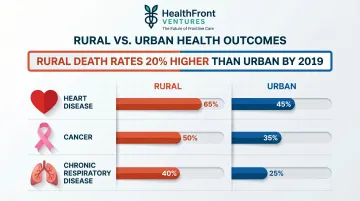
This investment targets the persistent gap between rural and urban health outcomes. Rural death rates were 20% higher than urban areas by 2019, with preventable mortality concentrated in several specific disease categories:
- Heart disease: Death rates in noncore rural counties exceed urban rates at measurable scale
- Cancer: Rural patients face longer travel times, later-stage diagnoses, and fewer specialist options
- Chronic respiratory disease: Occupational and environmental exposure compounds care access gaps
The RHTP is designed to address these outcomes structurally—rebuilding the rural care infrastructure that prevents deaths, not just treating patients after systems have already failed them.
Iowa's Healthy Hometowns Project: A Blueprint for Rural Care
Iowa branded its RHTP as the "Healthy Hometowns Project," administered through Iowa HHS. Rather than funding isolated projects, the program builds interconnected initiatives designed to reconstruct rural care infrastructure from the ground up—creating durable access points instead of temporary fixes.
Hometown Connections and Centers of Excellence
Hometown Connections builds local care pathways through up to ten Centers of Excellence covering:
- Maternal and child health
- Cancer prevention and treatment
- Cardiovascular disease management
- Behavioral health services
- Chronic disease care
The initiative includes school-based health partnerships using telehealth and mobile units, plus coordinated referral relationships among rural providers to ensure patients can access specialty care close to home.
Health Hubs and Co-location Models
Health Hubs represent coordinated rural care models where hospitals and providers build shared referral networks, business structures, and data systems. The hub model connects complementary providers so no single facility bears the full burden of service delivery.
Iowa has designated a Co-location Technical Assistance Provider to help rural facilities share staffing and physical space, including:
- Federally Qualified Health Centers (FQHCs)
- Behavioral health providers
- Social care agencies
- Community health organizations
Cancer Prevention and EMS Community Care
Iowa's cancer initiative coordinates screening, prevention, and detection across rural communities:
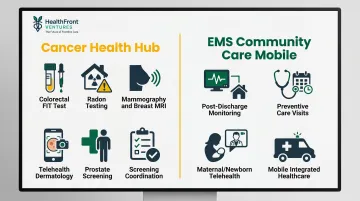
The Cancer Health Hub anchors this effort, connecting:
- Screening and prevention programs across participating rural sites
- FIT tests for colorectal cancer screening distributed to high-need areas
- Radon testing equipment to address lung cancer risk
- Expanded mammography with follow-up breast MRI
- Telehealth dermatology and new equipment for skin cancer detection
- Routine prostate screening programs
The EMS Community Care Mobile initiative extends that reach by moving care directly into homes and community sites. It expands EMS beyond emergency response to include:
- Post-discharge monitoring for high-risk patients
- Preventive care visits
- Telehealth coordination for maternal and newborn care
- Mobile integrated healthcare delivered in homes and community sites
What makes Healthy Hometowns notable is the architecture underneath it: shared data systems, formal referral agreements, and co-located services that keep working after initial funding cycles end. Iowa's model offers a replicable structure for other states designing their own rural health transformation programs.
The First Two RFP Awards: Medical Equipment and Workforce Recruitment
Medical Equipment Procurement and Installation (RFP #PHTHORC26009)
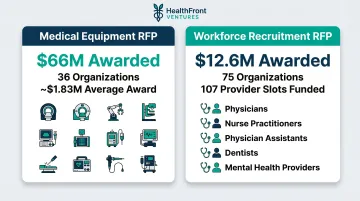
Iowa awarded $66,002,161.76 for medical equipment to 36 rural healthcare organizations, enabling them to introduce new lines of service not currently available in their regions.
Equipment Funded:
- MRI systems
- CT scanners
- PET/CT and SPECT nuclear imaging systems
- Digital X-ray and fluoroscopy
- Digital mammography
- Linear accelerators for cancer treatment
- Robotic surgical systems (da Vinci 5)
- Mako robotic-arm assisted surgery systems
- Ion robotic bronchoscopy systems
- Olympus endoscopy systems
The average award was approximately $1.83 million per organization, with funding covering procurement, installation, and minor facility modifications.
Healthcare Workforce Recruitment (RFP #PHTHORC26010)
Iowa awarded $12,600,000 for workforce recruitment to 75 organizations, covering 107 funded provider slots. Awards support competitive incentives including recruitment bonuses, relocation assistance, and other measures to attract providers committed to full-time, in-person rural practice.
Provider Types Funded:
- Family medicine, internal medicine, and pediatrics physicians
- Emergency medicine and general surgery physicians
- OB/GYN, psychiatry, and cardiology physicians
- Nurse practitioners (NPs) and certified nurse midwives (CNMs)
- Certified registered nurse anesthetists (CRNAs) and physician assistants (PAs)
- Registered nurses across specialties
- Behavioral health providers and radiology technologists
Together, these 107 funded provider slots signal how seriously Iowa is investing in the rural workforce pipeline — not just in facilities and technology, but in the clinicians who will staff them. These two RFPs represent only the initial portion of Iowa's $209 million total award. Additional Healthy Hometowns RFPs covering Health Hubs, co-location, EMS, cancer programs, and other initiatives are planned for release.
What Comes Next: Upcoming RFPs and How Rural Organizations Can Prepare
Additional Healthy Hometowns RFPs are expected to be released through Iowa HHS in the coming months, covering initiatives not yet funded in round one—Health Hubs, co-location support, cancer screening programs, EMS Community Care, and potentially school-based health partnerships.
Getting ahead of these opportunities now gives rural organizations a meaningful edge. Here's how to start.
Steps to Prepare
Monitor Funding Opportunities:
- Check the Iowa HHS Healthy Hometowns funding opportunities page regularly
- Subscribe to IowaGrants updates for RFP postings
- Join Iowa HHS webinars and information sessions
Align Your Programs:
- Map your current services to Healthy Hometowns initiative categories
- Identify service gaps where new programs could fit
- Build partnerships with other rural providers for coordinated applications
Document Baseline Data Now:
- Collect current workforce headcounts, vacancy rates, and service delivery gaps before the next RFP cycle opens
- Track outcomes for any workforce recruitment awards already received—funders will expect this data in future applications
- Establish repeatable reporting formats so metrics are ready when submission windows open
Strong applications require demonstrated baseline data, not estimates assembled at the last minute. Organizations that start tracking now will have a defensible record to draw from.
HealthFront Ventures' HealthFront Baseline™ is designed for exactly this stage. Launching in Q1 2026 with FY25 data, it provides rural healthcare organizations with quantitative workforce metrics—covering MD and NP/PA retention, recruitment ROI, and a Rural County Quality Measure—structured for RFP reporting requirements.
Frequently Asked Questions
What is Section 71401 Rural Health Transformation Program?
Section 71401 is the legislative provision in the One Big Beautiful Bill Act that authorized the $50 billion Rural Health Transformation Program. It directs CMS to fund states over five years to expand rural healthcare access, modernize infrastructure, strengthen workforces, and support care delivery innovation.
How much money is in the Rural Health Transformation Fund?
The total federal commitment is $50 billion over five years, administered by CMS at $10 billion annually. First-year state awards ranged from approximately $147 million to $281 million, with Iowa receiving $209,040,064 in year one.
Who can apply for the Iowa Rural Health Transformation Program?
Eligibility varies by RFP and typically covers rural hospitals, Federally Qualified Health Centers (FQHCs), Rural Health Clinics (RHCs), EMS agencies, behavioral health organizations, schools, and community-based organizations. Review each RFP directly for specific criteria, as requirements differ across funding rounds.
What is Iowa's Healthy Hometowns Project?
Administered by Iowa HHS, Healthy Hometowns is Iowa's branded RHTP. Its initiatives include Hometown Connections, Best and Brightest Provider Recruitment, Health Hubs, cancer prevention programs, co-location support, and EMS Community Care Mobile—each targeting a different dimension of rural healthcare delivery.
What types of organizations are eligible for Iowa's rural health equipment funding?
Rural hospitals and health systems were the primary eligible applicants, provided they were introducing service lines not currently available in their region. Funding covered procurement and installation of advanced diagnostic, surgical, and imaging technology, with minor facility modifications permitted.