Introduction
Healthcare organizations manage data scattered across EHRs, lab systems, claims platforms, imaging tools, and workforce databases. Most integration platforms were built for large urban health systems — not the full spectrum of care settings that actually exist across the US.
The gap is measurable. According to the ONC's 2023 Data Brief, only 36% of rural hospitals are routinely interoperable, compared to 47% of urban facilities. Independent hospitals face steeper barriers still: 55% lack complete interoperability, versus just 18% of system-affiliated facilities.
Platform choice has real consequences. The wrong fit leads to compliance risk, integration debt, manual workarounds, and wasted budget. The right one reduces those burdens and supports scalable, audit-ready data operations.
The regulatory pressure makes this urgent. CMS's $50 billion Rural Health Transformation Program requires measurable progress reporting, and information blocking penalties now reach $1 million per violation. Rural organizations can no longer afford fragmented data infrastructure. This guide compares leading healthcare data integration platforms across the criteria that matter most for rural and independent health settings.
Key Takeaways
- Traditional middleware platforms handle HL7-based EHR connectivity well but break down at scale and analytics readiness
- AI-native platforms manage real-time pipelines, cloud architectures, and automated normalization across clinical, workforce, and claims data
- Match your platform to organization size, IT capacity, and use case — clinical workflows, population health, and workforce analytics have different requirements
- Rural organizations face distinct gaps: limited IT staff, connectivity constraints, and workforce data needs that general platforms overlook
- HealthFront Baseline™ provides outsourced, analytics-ready workforce data infrastructure built specifically for rural HCP retention and recruiting
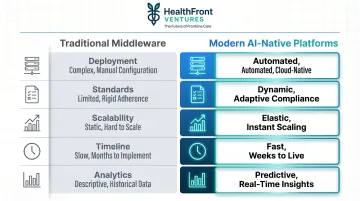
Traditional vs. Modern Platforms: Quick Comparison
| Dimension | Traditional Middleware | Modern AI-Native Platforms |
|---|---|---|
| Deployment | On-premises servers, manual interface builds | Cloud-native or hybrid, subscription-based access |
| Standards | Optimized for HL7 v2 | FHIR R4, REST APIs, X12, DICOM, HL7 simultaneously |
| Scalability | High upfront capital costs, per-interface labor | Operational expense model, elastic scaling |
| Timeline | 6-12+ months per integration project | Pre-built connectors, faster deployment cycles |
| Analytics | Routes messages, rarely produces analytics-ready datasets | Normalizes and enriches data for reporting and AI workloads |
The healthcare interoperability market reached $4.37 billion globally in 2025 and is projected to grow at 13.8% annually through 2035, driven primarily by cloud-native and API-first architectures. That growth assumption, however, runs into a hard constraint for rural healthcare: approximately 28% of rural residents lack broadband meeting the FCC's 100/20 Mbps benchmark — which means the "cloud-native" column in the table above isn't always a realistic option for the organizations that need interoperability most.
What Are Traditional Healthcare Data Integration Platforms?
To evaluate modern integration options, it helps to understand what traditional platforms were built to do — and where they fall short. Traditional middleware in healthcare consists of software engines — like Mirth Connect, Rhapsody, and Cloverleaf — that sit between systems, translate HL7 messages, and route data flows based on configured rules. Built for on-premises EHRs and closed hospital networks, they were designed for point-to-point connections, not ecosystem-wide interoperability.
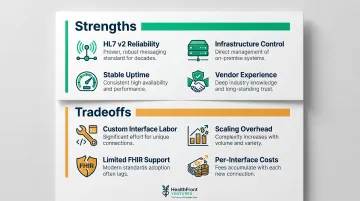
These platforms still hold genuine advantages in specific settings:
- Proven HL7 v2 reliability in high-volume clinical environments (ADT feeds, lab results, radiology orders)
- Full infrastructure control for organizations with strict data sovereignty requirements
- Stable uptime within tightly managed hospital networks
- Decades of vendor implementation experience across major health systems
Those strengths come with real tradeoffs, however — ones that compound as healthcare ecosystems grow more complex:
- Every new system connection requires custom-built interfaces and dedicated analyst time
- Scaling to new facilities or partners means additional servers and engineering overhead
- FHIR API support and real-time analytics are limited, typically added retroactively rather than built in
- Per-interface labor creates compounding costs as connection volumes grow